
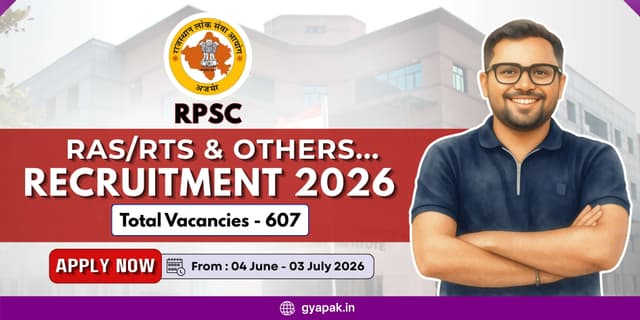
RPSC RAS/RTS Recruitment 2026 Introduction
The much-awaited announcement of Rajasthan Public Service Commission (RPSC) Rajasthan State and Subordinate Services Combined Competitive Examination 2026 has been announced. This elite recruitment drive offers a total of 607 vacancies and is a great chance for graduates to secure prestigious administrative, police and financial positions with the state government. The entire vacancy pool has been judiciously distributed among 192 administrative posts in the elite State Services like Rajasthan Administrative Service (RAS) and Rajasthan Police Service (RPS) and 415 vacancies in various Subordinate Services. The online application window will be open from 4th June, 2026 and candidates can submit their applications through the official Rajasthan Single Sign-On (SSO) portal till 3rd July, 2026. Eligible applicants aged between 21 and 40 will go through a rigorous three-stage selection process including an objective Descriptive Pre-screening Main written papers and final Personality Test. Selected candidates will be given standard 7th Pay Commission salary structures, good job security and powerful administrative positions that will help drive public welfare throughout the state of Rajasthan.
Important dates for RAS RTS Recruitment 2026
- Notification release date: May 27, 2026
- Online Application Starts: June 4, 2026
- Last date to apply: July 3, 2026
- RPSC RAS prelims date: To be notified soon
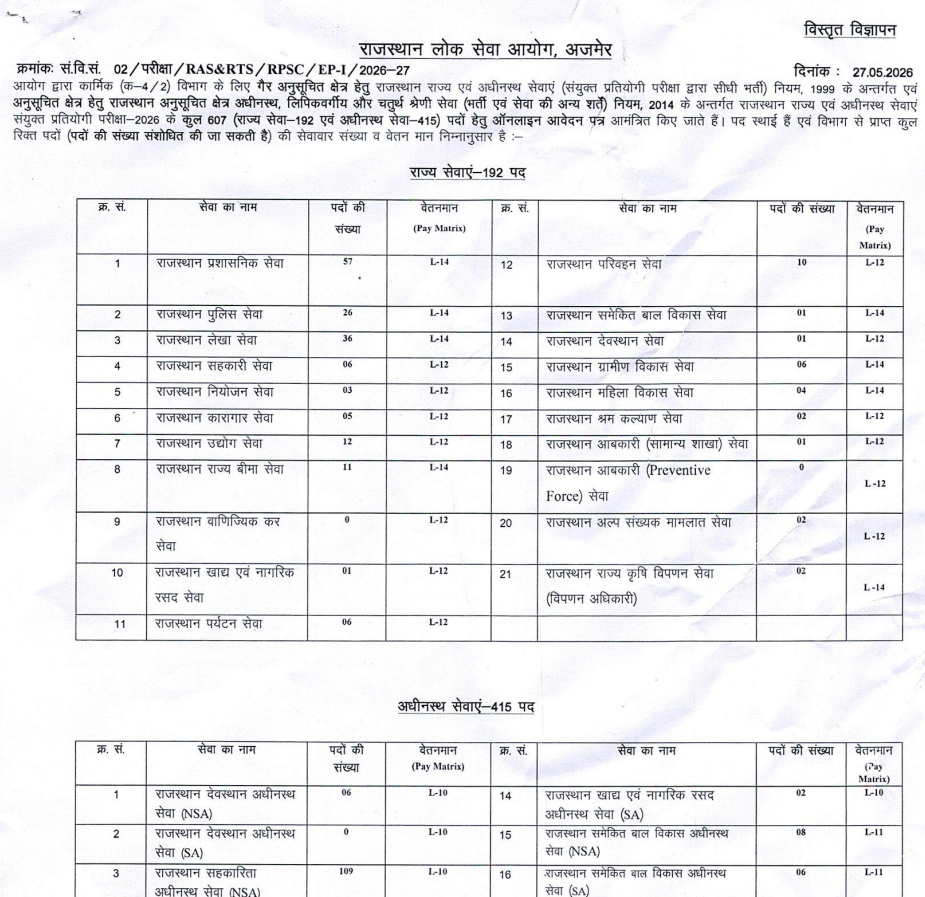
Vacancy Details for Rajasthan administrative jobs
| Name Of Post / Department | Total Vacancies |
|---|---|
| 1. State Services (Total: 192 Posts) | — |
| Rajasthan Administrative Service (RAS) | 57 |
| Rajasthan Accounts Service | 36 |
| Rajasthan Police Service (RPS) | 26 |
| Rajasthan Commercial Tax Service | 19 |
| Rajasthan Cooperative Service | 6 |
| Rajasthan Industry Service | 5 |
| Rajasthan State Insurance Service | 5 |
| Rajasthan Jail Service | 4 |
| Rajasthan Food & Civil Supplies Service | 4 |
| Rajasthan Employment Service | 3 |
| Rajasthan Local Self Government Service | 3 |
| Other Miscellaneous State Services | 24 |
| 2. Subordinate Services (Total: 415 Posts) | — |
| Rajasthan Tehsildar Service | 102 |
| Commercial Tax Subordinate Service | 95 |
| Cooperative Subordinate Service | 78 |
| Food & Civil Supplies Subordinate Service | 42 |
| Industry Subordinate Service | 25 |
| Excise Subordinate Service | 20 |
| Planning Subordinate Service | 15 |
| Social Justice & Empowerment Subordinate Service | 12 |
| Labor Welfare Subordinate Service | 10 |
| Other Miscellaneous Subordinate Services | 16 |
Eligibility Criteria for RPSC Rajasthan vacancy
Educational Qualification: Graduation / Bachelor’s Degree in any discipline from a recognized university. (Final-year students are also eligible to apply but must produce proof of passing before the Main Examination/Interview stage as specified). RPSC RAS age limit (as of January 1, 2027): * Minimum Age: 21 Years Maximum Age: 40 Years (Age relaxation applies to SC, ST, OBC, EBC, PwD, and female candidates of Rajasthan as per state government rules).
Application Fee for RPSC RAS/RTS Recruitment 2026
- General (Unreserved) / Creamy Layer OBC / Creamy Layer EBC: Rs 600
- Non-Creamy Layer OBC / Non-Creamy Layer EBC / EWS / SC / ST: Rs 400
- Divyangjan (Persons with Benchmark Disabilities - PwD): Rs 400
Selection Process for RPSC RAS/RTS Recruitment 2026
- 1Preliminary Exam Objective-type MCQ – 200 marks
- 2Main Exam Descriptive and analytical written papers, (4 papers, 800 marks)
- 3Personality Test/ Interview Evaluation of Character, personality and knowledge of Rajasthani culture (100 marks)
Salary During the 2-Year Probation Period (Fixed Remuneration)
In Rajasthan, selected candidates across all services serve a mandatory two-year probation period. During this time, they receive a fixed monthly remuneration without extra allowances (like DA or HRA). - Top State Services (Level 14 - e.g., RAS, RPS, Accounts Service): Fixed gross remuneration of approx. Rs. 39,300 per month. After a standard 10% deduction for the contributory pension fund, the net take-home pay is roughly Rs. 35,370 per month. - Subordinate Services (Level 10 to 12): Fixed monthly pay ranges between Rs. 23,700 and Rs. 31,100 depending on the specific grade level of the post.
Post Probation Salary of RAS RTS
| Service Category | Examples Of Posts | 7th CPC Pay Level (Pre 7th Grade Pay) | Initial Basic Pay | Estimated Gross Monthly Salary | Approx. In Hand Salary (Post Deductions) |
|---|---|---|---|---|---|
| Top State Services | RAS (SDM), RPS (DySP), Accounts Service, Commercial Tax Service | Level 14 (GP ₹5,400) | ₹56,100 | ₹95,000 – ₹1,00,000 | ₹82,000 – ₹88,000 |
| Intermediate State & Allied Services | Cooperative Service, Jail Service, Industry Service, Transport Service | Level 12 (GP ₹4,800) | ₹44,300 | ₹75,000 – ₹80,000 | ₹65,000 – ₹70,000 |
| Subordinate Services (Grade I) | Tehsildar Service, Excise Subordinate Service | Level 11 (GP ₹4,200) | ₹37,800 | ₹65,000 – ₹70,000 | ₹55,000 – ₹60,000 |
| Subordinate Services (Grade II) | Commercial Tax Subordinate Service, Food & Civil Supplies Subordinate | Level 10 (GP ₹3,600) | ₹33,800 | ₹58,000 – ₹62,000 | ₹48,000 – ₹52,000 |
Allowances and Perks (Post-Probation) in Rajasthan administrative jobs
In addition to the basic pay, permanent officers are entitled to extensive state government benefits: - Dearness Allowance (DA): Provided to balance inflation (calculated as a percentage of the basic pay, revised bi-annually). - House Rent Allowance (HRA): 20% of basic pay for Y-category cities (Jaipur, Jodhpur, Ajmer, Kota, Bikaner) and 10% for Z-category districts/rural towns. - Official Vehicle & Transport: Top-tier executive positions (like SDM/DySP) are provided an official government vehicle with a driver and fuel reimbursement for official duties. - Medical Benefits: Full medical coverage for the officer and dependent family members through the Rajasthan Government Health Scheme (RGHS). - Other Perks: Government accommodation/quarters (if available), electricity and telephone allowances, leaves with travel concessions (LTC), and highly stable job security.
RAS Exam Pattern
| Component | Details |
|---|---|
| Name of Paper | General Knowledge & General Science |
| Total Questions | 150 (Multiple Choice Questions) |
| Maximum Marks | 200 Marks |
| Time Duration | 3 Hours |
| Negative Marking | 1/3 Mark deducted for each wrong answer |
| Nature of Exam | Qualifying / Screening test only (Marks do not count for final merit) |
RAS syllabus for Prelims
The syllabus is broadly categorized into state-specific topics (which heavily dominate the paper) and national/international concepts: 1. History, Art, Culture, Literature, Tradition & Heritage of Rajasthan - Ancient Era: Pre-historical sites (Palaeolithic to Chalcolithic and Bronze Age), archaeological sources, and major early centres. - Dynasties & Rulers: Achievements of major dynasties like Guhila, Pratihar, Chauhan, Parmar, Rathore, Sisodiya, and Kachchawa, along with medieval administrative and revenue systems. - Modern Awakenings: Peasant and Tribal movements, Praja Mandal movements, role of newspapers/institutions, and the final Integration of Rajasthan. - Art & Architecture: Forts, palaces, temples, man-made water bodies, various schools of paintings, and handicrafts. - Performing Arts: Folk dances, folk drama, classical/folk music, and musical instruments. - Literature & Society: Dialects of Rajasthani language, folk literature, fairs, festivals, customs, attires, ornaments, folk deities, and leading historical personalities. 2. Indian History (Ancient, Medieval & Modern) - Ancient & Medieval: Indus Valley & Vedic Age; Buddhism and Jainism; prominent rulers of major dynasties (Maurya, Kushan, Satavahan, Gupta, Chalukya, Pallava, Chola, Delhi Sultanate, and Mughals); Bhakti and Sufi movements. - Modern Period (Early 19th Century to 1964): Rise of British power and local resistance; Emergence of Nationalism; Freedom struggle and the Indian National Movement (various stages and major contributors); Social and religious reform movements; Post-independence consolidation. 3. Geography (World, India & Rajasthan) - World Geography: Major landforms (mountains, plateaus, plains, deserts), types of agriculture, major industrial regions, and global environmental issues. - Geography of India: Physiographic divisions, monsoon mechanism, rainfall distribution, major rivers, lakes, crops, minerals, power resources, and major transport corridors. - Geography of Rajasthan: Physiographic regions, climatic characteristics, drainage systems, vegetation, soil types, wildlife and biodiversity, environmental issues, major irrigation projects, and population demographics. 4. Indian Constitution, Political System & Governance -Constitutional Framework: Constituent Assembly, Preamble, Fundamental Rights, Directive Principles of State Policy (DPSP), Fundamental Duties, and major Constitutional Amendments. - Union Government: Structure and function of the Parliament, Judiciary, President, and Prime Minister. - Governance Ecosystem: Public Policy, Rights issues (Citizen's Charter, RTI, Lokpal, NHRC), and the 3-tier Panchayati Raj institutions. 5. Political and Administrative System of Rajasthan - State Administration: Executive powers of the Governor, Chief Minister, and Council of Ministers. - State Institutions: Legislative Assembly, Rajasthan High Court, Subordinate Courts, and RPSC. - Local Governance & Statutory Bodies: District Administration, Local Self-Government (Panchayati Raj and Municipalities), State Human Rights Commission, State Election Commission, Lokayukta, and State Information Commission. 6. Economic Concepts and Indian / Rajasthan Economy - Macroeconomics: National Income, Budgeting, Banking, Monetary & Fiscal Policies, GST, Subsidies, Public Distribution System (PDS), and control mechanisms for Inflation. - Economic Development: Human Development Index (HDI), core sectors (Agriculture, Industry, Service), and poverty/unemployment indices. - Economy of Rajasthan: Macro overview of the state's agriculture, industrial sectors, infrastructural developments, and major welfare schemes or financial policies. 7. Science & Technology - Everyday Science: Basics of physics, chemistry, and biology. - Advanced Technologies: Information & Communication Technology (ICT), Space Tech, Satellites, Defense Tech, Nanotechnology, Biotechnology, and Genetic Engineering. - Health & Environment: Food and nutrition, blood groups, health care systems, environmental hazards, global warming, and biodiversity conservation. 8. Reasoning, Mental Ability & Basic Numeracy - Logical & Analytical Reasoning: Statements and assumptions, arguments, conclusions, courses of action, and analytical problem-solving. - Mental Ability: Number/letter series, coding-decoding, blood relations, direction sense, Venn diagrams, and seating arrangements. - Basic Numeracy: Ratio & proportion, partnership, profit & loss, percentage, simple and compound interest, permutation & combination, basic probability, data analysis (tables, charts, graphs), and central tendencies (mean, median, mode). 9. Current Affairs - Major current events of state (Rajasthan), national, and international importance. - Prominent personalities, recently highlighted places, games, sports competitions, and latest state/central institutional awards.
How To Apply for Rajasthan administrative jobs
- 1Go to the official Rajasthan SSO website: sso.rajasthan.gov.in
- 2If you do not have an account, click on "Registration". You can register using your Jan Aadhaar card, Google account, Bhamashah ID.
- 3If you already have an account, log in using your SSO ID and Password.
- 4Once Logged into the dashboard, click on the Recruitment Portal icon.
- 5Click on the "One-Time Registration (OTR)" tab.
- 6Enter your details exactly as they appear on your secondary school marksheet. Verify your details carefully and submit to generate your unique OTR Number.
- 7Pay the registration fee online (one-time). Once you pay, you will not be required to pay application fees for any further Rajasthan government job exams.
- 8Back to the Recruitment Portal Dashboard Visit the “ongoing recruitments” and click on the link of “Rajasthan State and Subordinate Services Combined Competitive Examination 2026.
- 9Click on "Apply Now". Your basic credentials will automatically be fetched from your OTR profile.
- 10Upload your required documents, photograph and signature. Preview the filled application form.
- 11Accept the declaration box and click on “Final Submit”. Download and print a copy of the application for your records.
New Rules for the RAS prelims Examination
Prelims “Fifth Option” (Option ‘E’): RPSC strictly follows 5 option Multiple Choice Questions (A, B, C, D, E). If you don’t know the answer to a question and want to leave it blank, you must fill in the fifth circle ('E'). If you leave a question totally blank (ie don't scratch 'E') you lose 1/3 of a mark. 10% Disqualification Limit: A candidate will be disqualified if he/she does not circle/select any option at all for more than 10% of total questions (i.e. more than 15 questions out of 150) for which ‘E’ is not selected, irrespective of his/her score in the exam. Additional Time for OMR Bubble Filling:Candidates are given 10 minutes grace period after the normal exam duration of 3 hours to re-check their OMR answer sheets for the purpose of choosing the fifth option.
Preparation Tips for RAS RTS recruitment 2026
- Download the syllabus and paste it on your study desk. Stick to the strictly preparation stuff. It would cut down your time spent on stuff that is irrelevant.
- Roughly 35 to 40 percent of the Prelims paper is directly connected to the history, geography, economy and culture of Rajasthan. To understand this section well, refer the standard state board textbooks or recognised regional guidebooks.
- Emphasise the articles of the last 8 to 12 months for current affairs. Rajasthan state government policies, flagship welfare schemes, budget allocation, economic review.
- Get used to the compulsory fifth option (Option 'E'). Practice with OMR sheets so you get used to the idea of automatically darkening the 'E' for skipped questions without marking negative or getting disqualified.
- In Prelims, mental ability & numeracy is the section where you can easily score 20 to 25 high scoring marks. Practise previous years question papers regularly to develop speed and accuracy.
- Before the actual exam, take at least 15 to 20 full-length sectional and comprehensive mock tests. This allows you to time yourself and hone your elimination techniques for the real paper.
Comments
Login to join the discussion
Log inNo comments yet