

UPSC NDA 2 Recruitment 2026 Introduction
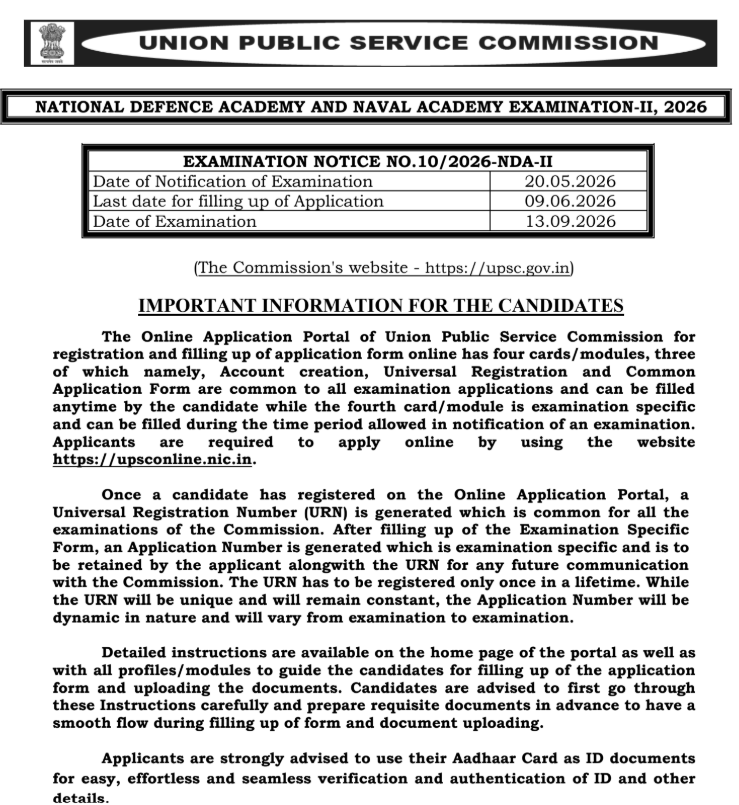
The Union Public Service Commission (UPSC) has officially released the notification for the National Defence Academy and Naval Academy Examination (II), 2026. The commission has announced 394 vacancies this year in the Army, Navy and Air Force wings and the 10+2 Cadet Entry Scheme of the Naval Academy. It is a great opportunity for young unmarried male and female candidates who want to join Defence jobs as commissioned officers and serve the nation immediately after completing their higher secondary education. The eligible candidates can apply online for the NDA 2 registration form 2026 through the official website of UPSC from May 20, 2026. The last date for the submission of online applications is June 9, 2026.
Vacancy Breakdown of UPSC NDA exam
| Academy / Wing | Branch / Entry | Male Vacancies | Female Vacancies | Total |
|---|---|---|---|---|
| National Defence Academy (NDA) | Army | 198 | 10 | 208 |
| — | Navy (All Executive) | 37 | 05 | 42 |
| — | Air Force (Flying) | 90 | 02 | 92 |
| — | Air Force (Ground Duties - Tech) | 16 | 02 | 18 |
| — | Air Force (Ground Duties - Non-Tech) | 08 | 02 | 10 |
| Naval Academy (NA) | 10+2 Cadet Entry Scheme | 21 | 03 | 24 |
| Total | — | 370 | 24 | 394 |
Important Dates for UPSC Defence jobs
- Notification & Application Start Date: May 20, 2026
- Last Date to Apply Online: June 9, 2026 (until 6:00 PM)
- Application Correction Window: June 10 to June 16, 2026
- UPSC NDA 2 Exam Date: September 13, 2026
- Course Commencement: July 1, 2027 (158th Course of NDA and 120th INAC)
Educational Qualification for UPSC NDA 2 Recruitment 2026
- For Army Wing: Passed or appearing in Class 12 (10+2 pattern) or equivalent examination from a recognised board (Any stream/subject combination). - For Air Force, Navy Wings and Naval Academy: Passed or appearing in Class 12 with Physics and Mathematics as compulsory subjects. Age & Marital Status - Only unmarried male and female candidates are eligible. - Date of Birth: The candidates should have been born not before 2nd January 2008 and not later than 1st January 2011.
Selection Process & UPSC NDA Exam Pattern
- 1Written Examination (Offline Mode - Objective Type) Paper 1: Mathematics | 120 Questions | 2½ Hours | 300 Marks Paper 2: General Ability Test (GAT) | 150 Questions | 2½ Hours | 600 Marks (English: 200 Marks, GK: 400 Marks)
- 2SSB Interview / Personality Test (5-Day Process) | 900 Marks
- 3Document Verification & Medical Examination
How to Apply for NDA 2 registration form 2026
- 1Go to the official website: upsconline.nic.in.
- 2Complete the One-Time Registration (OTR) process if you've not yet done.
- 3Sign in and navigate to the application form for NDA & NA (II) 2026 by entering your login details.
- 4Enter your personal details, preferences for streams and select your preferred exam location.
- 5Upload scanned copies of your photograph, signature and valid photo id card.
- 6Registration Fee of Rs.100/- is to be paid by the candidates (SC, ST, female candidates and Wards of JCOs/NCOs/ORs are fully exempted).
- 7Verify and submit the form (don’t forget to download or print the final confirmation).
Stipend During UPSC NDA Training Period
Selected male and female candidates are trained at the service academies (NDA, IMA, INA or AFA) before commissioning as regular officers. Fixed Cadet Stipend: Rs. 56,100/- per month (Initial pay in Level 10 of Defence Pay Matrix). Note: During this period, the government shall fully provide the boarding, lodging, medical facilities and uniforms.
Post-Commission Rank-Wise Salary Structure
| Rank / Position | Pay Level | Basic Pay Scale (Per Month) |
|---|---|---|
| Lieutenant / Equivalent | Level 10 | ₹56,100 – ₹1,77,500 |
| Captain / Equivalent | Level 10B | ₹61,300 – ₹1,93,900 |
| Major / Equivalent | Level 11 | ₹69,400 – ₹2,07,200 |
| Lieutenant Colonel / Equivalent | Level 12A | ₹1,21,200 – ₹2,12,400 |
Major Allowances & Perks in UPSC Defence jobs
The basic pay of a newly commissioned officer is much less than the actual in-hand salary. A wide range of mandatory and location-based allowances are given: - Military Service Pay (MSP): Fixed amount of Rs 15,500 per month paid to all officers from the rank of Lieutenant to Brigadier to compensate for the unique nature of military service. - Dearness Allowance (DA) : As per the standard central government inflation adjusted rates (on Basic Pay + MSP) - House Rent Allowance (HRA): Ranges from 8% to 24% of the basic pay, depending on whether the posting is in a Class X, Y, or Z city (not applicable if government accommodation is provided). - Transport Allowance (TPTA): Rs 3,600 to Rs 7,200 per month + DA thereon, depending on the posting location.
Risk & Hardship Allowances
Flying Allowance Rs. 25,000 per month for Army Aviators (Pilots) and Officers of Air Force Flying branch. (b) Siachen Allowance Rs. 42,500/- per month (for posting in Siachen Glacier region). - Highly Active Field Area Allowance Rs 16,900 per month. - Field Area Allowance: Rs. 10,500/- month. - Special Forces Allowance : Rs. 25,000/- per month.
UPSC NDA 2 recruitment 2026 syllabus
The written examination for UPSC Defence jobs consists of two objective papers, which are conducted on the same day. The UPSC NDA 2 recruitment 2026 syllabus includes core concepts from Classes 10, 11, and 12. Paper 1: Mathematics (Code No. 01) - Total Marks: 300 | Total Questions: 120 | Duration: 2½ Hours - Marking Scheme: +2.5 for correct answers; -0.83 for incorrect answers This paper tests conceptual depth and calculation speed across eight core mathematical domains: - Algebra: Concept of sets, Venn diagrams, De Morgan laws, Cartesian product, relation and equivalence relations. Real numbers, complex numbers (modulus, argument, cube roots of unity), binary number system and conversions. Arithmetic, Geometric, and Harmonic progressions (AP, GP, HP). Quadratic equations with real coefficients. Permutations and Combinations ($^nP_r$ and $^nC_r$), Binomial theorem, and Logarithms. - Matrices & Determinants: Types of matrices, operations (addition, multiplication). Determinants of a matrix and basic properties. Adjoint and inverse of a square matrix. Applications including solving systems of linear equations using Cramer's Rule and the Matrix Method. - Trigonometry: Angles and their measures in degrees and radians. Trigonometric ratios and basic identities. Sum and difference formulas, multiple and sub-multiple angles. Inverse trigonometric functions. Applications including heights, distances, and properties of triangles. - Analytical Geometry of 2D & 3D: 1) 2D: Rectangular Cartesian coordinate system, distance formula, various forms of the equation of a line, angle between lines, distance of a point from a line. Standard and general equations of a circle, parabola, ellipse, and hyperbola (including eccentricity and axes). 2) 3D: Points in a 3D space, distance formula, direction cosines and direction ratios, equations of a line and a plane, angle between two lines/planes, equation of a sphere. - Differential Calculus: Real-valued functions (domain, range, and graphs), composite functions, one-to-one, onto, and inverse functions. Notion of limits and standard limits. Continuity and basic algebraic operations on continuous functions. Derivative of a function, geometrical and physical interpretations. Derivatives of sums, products, quotients, composite functions, and second-order derivatives. Applications in increasing/decreasing functions and maxima/minima problems. - Integral Calculus & Differential Equations: Integration as the inverse of differentiation. Integration by substitution and by parts. Standard integrals involving algebraic, trigonometric, exponential, and hyperbolic functions. Evaluation of definite integrals and determination of areas bounded by curves. Definition of order and degree of a differential equation, formation of differential equations, and solutions of first-order, first-degree differential equations (including growth and decay models). - Vector Algebra: Vectors in 2D and 3D space, magnitude and direction. Unit and null vectors. Addition of vectors and scalar multiplication. Scalar (dot) product and vector (cross) product of two vectors. Applications in calculating work done by a force, moment of a force, and geometric problems. Statistics & Probability: - Statistics: Classification of data, frequency distributions, cumulative frequency. Graphical representations (Histograms, Pie Charts, frequency polygons). Measures of central tendency (Mean, Median, Mode). Variance and standard deviation. Correlation and regression. - Probability: Random experiments, sample space, mutually exclusive and exhaustive events. Classical and statistical definitions of probability. Elementary theorems, conditional probability, Bayes' Theorem. Random variables and Binomial distributions.
UPSC NDA Paper 2: General Ability Test (GAT)
- Total Marks: 600 | Total Questions: 150 | Duration: 2½ Hours - Marking Scheme: +4.0 for correct answers; -1.33 for incorrect answers The GAT is divided into two distinct sections: Part A (English) and Part B (General Knowledge). Part A: English (200 Marks / 50 Questions) Designed to test the candidate's understanding and textbook command of the English language. - Grammar and usage rules - Spotting errors in sentences - Sentence improvement and rearrangement - Synonyms and Antonyms - Idioms and Phrases - Reading comprehension passages
Part B: General Knowledge (400 Marks / 100 Questions)
| Section | Subject | Weightage | Core Topics & Focus Areas |
|---|---|---|---|
| Section A | Physics | 25% | States of matter, mass, weight, density, specific gravity, Archimedes’ principle, barometer. Motion, velocity, acceleration, Newton's laws of motion, force, momentum. Work, power, energy. Heat, temperature, change of state, latent heat, modes of heat transfer. Sound waves and properties. Light (reflection, refraction, spherical mirrors, lenses, human eye). Static and current electricity, Ohm’s law, simple circuits, magnetic effects of current. |
| Section B | Chemistry | 15% | Physical and chemical changes. Elements, mixtures, and compounds. Chemical symbols, formulas, and simple equations. Laws of chemical combination. Properties of air and water. Preparation and properties of Hydrogen, Oxygen, Nitrogen, and Carbon Dioxide. Oxidation and reduction. Acids, bases, and salts. Carbon and its allotropes. Natural and artificial fertilizers. Basic composition of soap, glass, ink, paper, cement, and safety matches. Atomic structure, atomic weight, valency. |
UPSC NDA exam Day Instructions
Mandatory Entry Timings The written exam will be conducted in two different shifts on 13th September, 2026. UPSC strictly closes the gate for entry 10 minutes before each session starts. - Morning Shift (Mathematics): 10:00 AM to 12:30 PM | Gates Close Permanently at 9:50 AM - Afternoon Shift (GAT): 2:00 PM to 4:30 PM | Gates Close Permanently at 1:50 PM - Note: Under no circumstances will any candidate be allowed into the venue once the gates are closed. Reach the exam centre at least 45-60 minutes before the exam for security checks
Required Documents for UPSC NDA 2 exam
- e-Admit Card: Download and print from the official UPSC site.
- Photo ID Original Proof: Carry the exact identity card which is mentioned on your admit card (Aadhaar Card, PAN Card, Voter ID or Passport).
- Photographs (Passport Size): Take two identical passport size photos (one for each shift). If the photo on your admit card is blurred, or missing, these are Mandatory.
Recommended Dress Code in UPSC NDA exam
Male Candidates: Plain t-shirts or casual shirts paired with regular trousers or jeans. Avoid clothes with large graphic prints, multiple pockets (like cargo pants), or hoods. Closed formal shoes or simple sneakers are highly recommended. Female Candidates: Simple kurtis with leggings, formal shirts with trousers, or basic salwar suits. Heavy embroidery, metallic elements, and elaborate layers should be avoided. Footwear & Accessories: Choose flat, comfortable footwear. High heels, thick-soled shoes, sandals with heavy buckles, and excessive jewellery (rings, bracelets, necklaces) are heavily discouraged and will delay security checks. Watches: Traditional analogue wristwatches or smartwatches are completely banned inside the exam hall. Every room is equipped with a wall clock to monitor the time.
Comments
Login to join the discussion
Log inNo comments yet