
SSC CGL 2026 Introduction
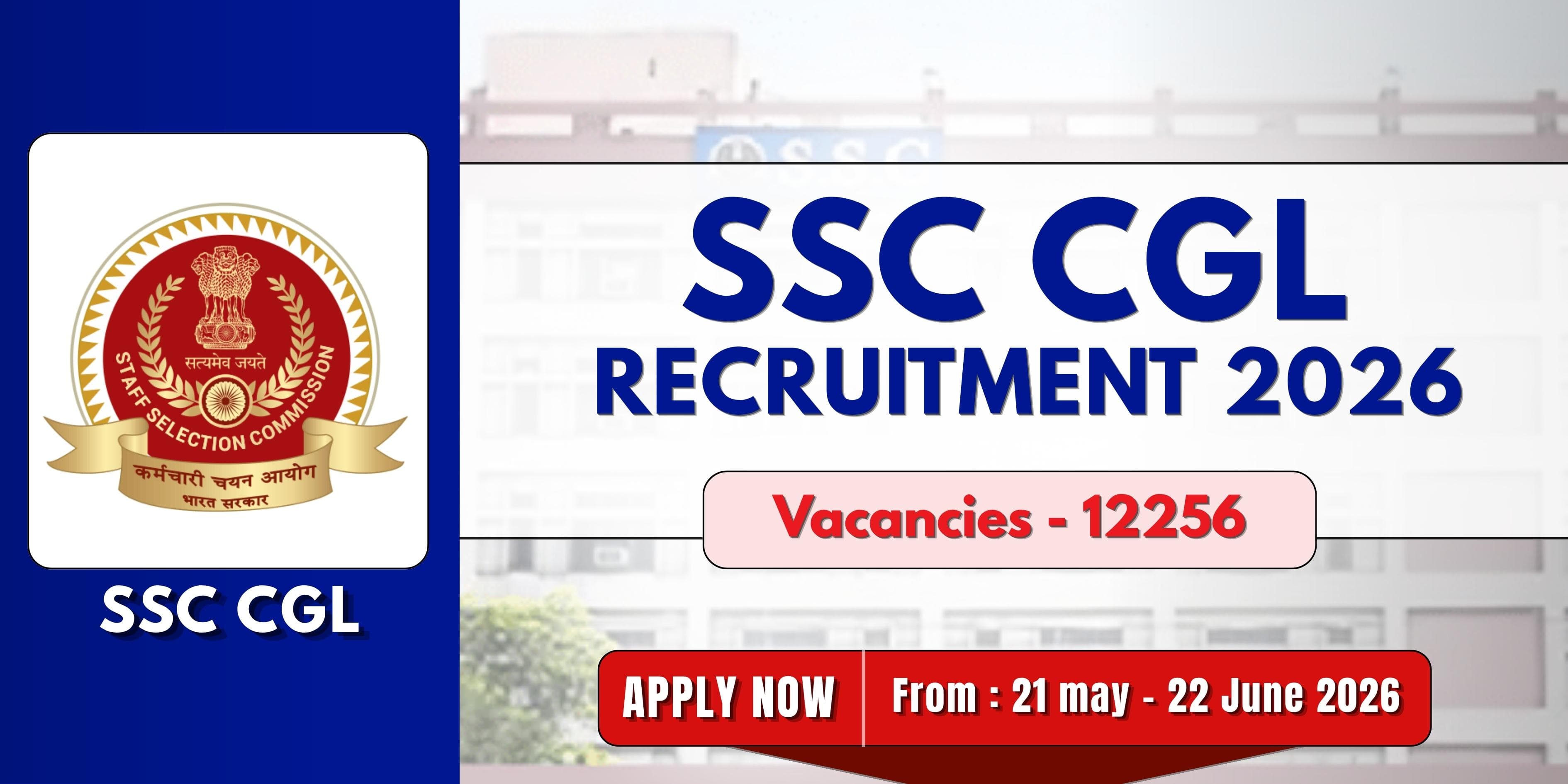
The Staff Selection Commission has officially released the much awaited SSC CGL 2026 Notification on May 21, 2026, marking the beginning of one of the biggest central government recruitment drives in India. The commission has so far this year announced a whopping 12,256 tentative vacancies for 40 different Group B and C posts in premium ministries, departments and organisations. The online application window is now open on the official website ssc.gov.in, which is a great opportunity for eligible graduates to land a safe and reputable career in the central bureaucracy. The last date for the online registration and submission of the form by the aspirants is June 22, 2026. The current recruitment cycle brings important updates, such as the mandatory use of the live photograph feature while filling out the application and strict sectional timings for Computer-Based Tests. The Tier-I preliminary examinations would be held in August-September 2026 providing a clear time frame to the candidates to complete their preparation and compete for coveted posts such as Income Tax Inspectors, Assistant Section Officers and Central Excise Inspectors.
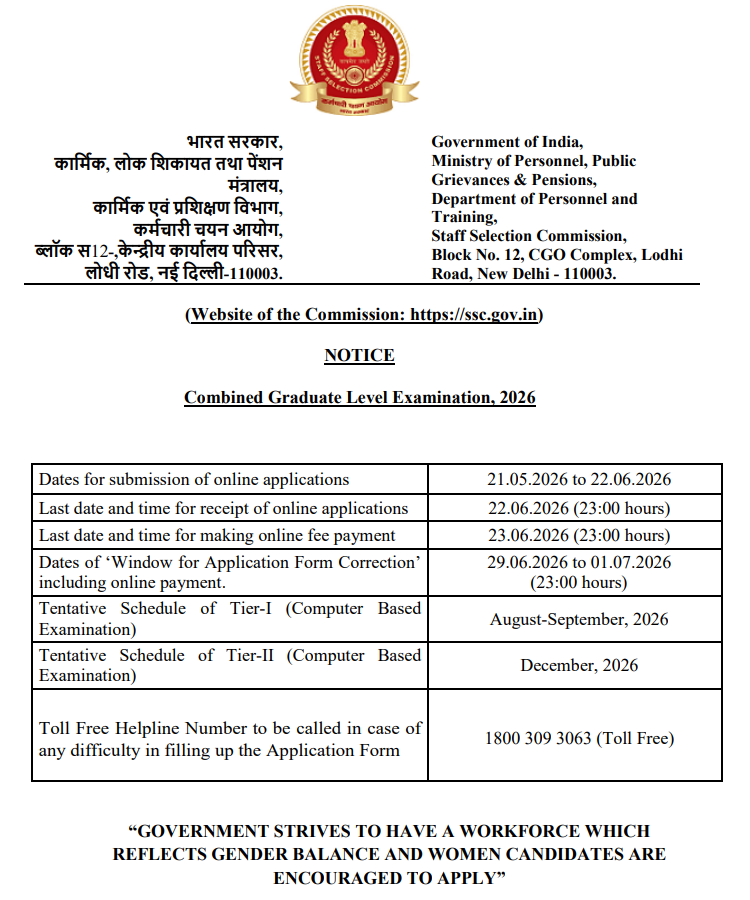
Important Dates for SSC CGL Group B and C posts
- Notification Release Date: May 21, 2026
- Online Application Start Date: May 21, 2026
- Last Date to Apply Online: June 22, 2026 (11:00 PM)
- Last Date for Online Fee Payment: June 23, 2026 (11:00 PM)
- Application Form Correction Window: June 29 to July 1, 2026 (11:00 PM)
- SSC CGL Tier-I Exam Date (CBT): August – September 2026
- SSC CGL Tier-II Exam Date (CBT): December 2026
SSC CGL qualification eligibility
Educational Qualification: A Bachelor's Degree in any stream from a recognized university. - For Junior Statistical Officer (JSO): Bachelor's degree with at least 60% marks in Mathematics at the Class 12th level OR a Bachelor's Degree with Statistics as one of the subjects. - Final Year Students: Can apply provisionally, provided their graduation results are declared and completed before the specified cut-off date (August 1, 2026). Age Limit: Generally 18 to 32 years (varies post-wise). Standard age relaxations apply (3 years for OBC, 5 years for SC/ST, and 10 years for PwBD).
Application Fee for SSC CGL 2026
For SSC Group C Jobs the application fee is Rs 100 for General/OBC/EWS males. All female candidates and SC/ST/PwBD/Ex-Servicemen are entirely exempted from the fee.
Pay Structure of Group B and C posts in SSC CGL
The vacancies are spread across multiple high-profile roles divided into distinct Pay Levels: • Pay Level-7 (₹44,900 – ₹1,42,400): Assistant Section Officer (CSS, IB, MEA, Railways), Inspector of Income Tax (CBDT), Inspector of Central Excise/Preventive Officer/Examiner (CBIC), and Assistant Enforcement Officer. • Pay Level-6 (₹35,400 – ₹1,12,400): Divisional Accountant (C&AG), Sub-Inspector (CBI, NIA), and Junior Statistical Officer (MPSI). • Pay Level-5 & 4 (₹25,500 – ₹92,300): Auditor, Accountant, Tax Assistant (CBDT/CBIC), and Senior Secretariat Assistant.
SSC CGL Selection Process
- 1
Tier-I Examination (Screening Round) Computer-Based Test (CBT) with multiple-choice questions.
- 2
Tier-II Examination Computer-Based Test (CBT) conducted over multiple sessions on a single day.
- 3
Post-Specific Physical & Endurance Tests
- 4
Post Preference Allocation & Document Verification (DV)
Job location for SSC Group C Jobs
The job location of an SSC CGL post is not restricted to one city, it is spread across the country and it majorly depends on the Ministry, Department and Post you opt for and get allocated to. The posting is done on systematic basis of “Merit-cum-Preference” basis. After the declaration of the Tier-II results, you will be asked to fill up the Option-cum-Preference form. Your final posting is decided on the basis of your rank and availability of state wise/zone wise vacancies of that department. The job locations are generally categorised as follows: Permanently Posted in New Delhi (Metro Culture) These ministry-based posts are ideal for those looking for a stable, desk-bound career with no frequent inter-state transfers. They are based virtually exclusively at the headquarters in New Delhi: Assistant Section Officer (ASO) in the Central Secretariat Service (CSS), Ministry of Railways, Armed Forces Headquarters (AFHQ), Intelligence Bureau (IB), and various other central ministries. Inspectors/Assistants in central commissions like the Election Commission, Central Administrative Tribunal (CAT), and CIC. Pan-India Posting (State & Zone Cadres) For these posts, vacancies are distributed across regional offices, field units, and state capitals nationwide. Global / Foreign Postings ASO in MEA: This is the only post in SSC CGL which has scope for overseas postings. You will be initially posted at the headquarters in New Delhi but would also be eligible for rotational postings at Indian embassies and consulates abroad (e.g. Washington, Berlin, Tokyo, Dubai) depending on your seniority and departmental requirements. City Classification & Allowances Your final location also determines your exact salary. The Government of India classifies cities into three tiers for calculating House Rent Allowance (HRA): X Cities (Metros): Delhi, Mumbai, Kolkata, Chennai, Bengaluru, Hyderabad, Pune, Ahmedabad. (Highest HRA) Y Cities: Major urban centers, including state capitals like Jaipur, Lucknow, Patna, Chandigarh, etc. Z Cities: Rural areas, smaller towns, and remaining tier-3 regions.
How to apply for SSC CGL Recruitment 2026
- 1Go to ssc.gov.in. On the top right of the homepage, click on the "Login or Register" button and select "Register Now".
- 2Fill in your critical identity details: Aadhaar Number (or alternative Govt ID), your full name, Father’s name, Mother’s name, Date of Birth, and Gender. Note: Ensure all spellings match your Class 10th (Matriculation) certificate exactly to avoid disqualification during Document Verification.
- 3Input your active mobile number and email ID. Click to generate OTPs for both, verify them, and click save to generate your permanent Registration ID and temporary password.
- 4Log in using your new Registration ID and temporary password (you will be prompted to change your password immediately). Complete your profile by entering your Nationality, Category (UR/OBC/EWS/SC/ST), visible identification marks, and permanent address. Read the declaration and hit Final Submit.
- 5Once your OTR profile is ready, log back into the candidate dashboard to submit your specific application for the Graduate Level posts.
- 6
Pay Level-7 Posts (Pay Scale: ₹44,900 – ₹1,42,400)
| Ministry / Department | Post Name | UR | OBC | SC | ST | EWS | Total |
|---|---|---|---|---|---|---|---|
| CBIC (Finance) | Inspector (Central Excise) | 611 | 269 | 175 | 82 | 169 | 1306 |
| DoPT |
Pay Level-6 & Level-5 Posts (Pay Scale: ₹29,200 – ₹1,12,400)
| Ministry / Department | Post Name | UR | OBC | SC | ST | EWS | TOTAL |
|---|---|---|---|---|---|---|---|
| CGDA | Auditor | 477 | 316 | 176 | 88 | 117 | 1174 |
Pay Level-4 Ministerial Support Roles (Pay Scale: ₹25,500 – ₹81,100)
| Ministry / Department | Post Name | UR | OBC | SC | ST | EWS | TOTAL |
|---|---|---|---|---|---|---|---|
| CBDT (Finance) | Tax Assistant (Income Tax) | 572 | 340 | 171 | 80 | 86 | 1249 |
Tier-I: Computer Based Examination (Qualifying)
| Section / Subject | Questions | Max Marks | Sectional Timer | Negative Marking |
|---|---|---|---|---|
| A. General Intelligence & Reasoning | 25 | 50 | 15 Minutes | -0.50 |
| B. General Awareness | 25 | 50 | 15 Minutes | -0.50 |
| C. Quantitative Aptitude |
Tier-II: Computer Based Examination (Rank-Determining)
Segment 1: Math & Reasoning (1 Hour Total) Time Split: 30 minutes for Math, then 30 minutes for Reasoning. Questions: 30 Math + 30 Reasoning = 60 Questions total Marks: 180 Marks (3 marks per question) Segment 2: English & General Awareness (1 Hour Total) Time Split: 40 minutes for English, then 20 minutes for General Awareness. Questions: 45 English + 25 General Awareness = 70 Questions total Marks: 210 Marks (3 marks per question) Segment 3: Practical Qualifying Tests (30 Minutes Total) These do not add to your merit score, but you must pass them. Computer Test (15 Mins): 20 multiple-choice questions about basic computer knowledge. Typing Test (15 Mins): Type about 2,000 keystrokes (around 27 words per minute).
SSC CGL 2026 expected syllabus
1. Quantitative Aptitude (Math) The math syllabus tests basic numerical capability in Tier-I and shifts toward intensive core conceptual problem-solving in Tier-II. • Arithmetic: Percentages, Profit, Loss & Discount, Ratio & Proportion, Simple & Compound Interest, Time & Work, Time, Speed & Distance, Averages, Mixtures & Alligations, Partnership. • Algebra: Basic Algebraic Identities, Surds & Indices, Linear Equations and their graphs. • Geometry: Triangles (congruence, similarity, centers), Circles (chords, tangents, angles subtended by chords), Quadrilaterals, Regular Polygons. • Mensuration: Area and volume of 2D/3D shapes (Prisms, Cones, Cylinders, Spheres, Hemispheres, Pyramids). • Trigonometry: Trigonometric Ratios, Complementary Angles, Height and Distances, Simple Identities. • Data & Statistics: Histograms, Frequency Polygons, Bar Diagrams, Pie-charts. (Tier-II adds basic Probability, Mean, Median, Mode, Standard Deviation). 2. General Intelligence & Reasoning This section assesses logical, verbal, and non-verbal reasoning skills. It is highly scoring if you grasp the basic patterns. • Verbal Reasoning: Analogy (Semantic, Symbolic, Number), Coding-Decoding, Blood Relations, Syllogism, Venn Diagrams, Direction Sense Test, Clock & Calendar, Matrix, Word Building. • Critical Reasoning: Statement & Conclusions, Statement & Assumptions, Course of Action, Cause & Effect, Assertion & Reasoning. • Non-Verbal Reasoning: Series completion (Number & Figural), Classification, Paper Folding & Unfolding, Embedded Figures, Mirror & Water Images, Pattern Completion, Cubes & Dice. 3. English Language & Comprehension This section focuses on grammar proficiency, vocabulary depth, and contextual reading speed. • Grammar & Mechanics: Spotting the Error, Sentence Improvement, Fill in the Blanks, Active/Passive Voice conversions, Direct/Indirect Speech transformation. • Vocabulary: Synonyms & Antonyms, One-word Substitutions, Idioms & Phrases, Spelling Error detection, Cloze Test (contextual vocabulary blanks). • Reading Proficiency: Para Jumbles (Sentence Rearrangement) and Reading Comprehension passages (Tier-II includes multiple complex editorial or narrative passages). 4. General Awareness The vastest section of the exam. Questions test everyday knowledge, historical context, and current events. • Static GK: Indian History (Ancient, Medieval, Modern), Indian Geography & World Geography, Indian Polity & Constitution, Indian Economy (Budget, Five-Year Plans, Supply & Demand fundamentals). • General Science: Physics, Chemistry, and Biology fundamentals up to Class 10 standard. • Miscellaneous & Current Affairs: National & International Events (last 6-8 months), Government Schemes, Books & Authors, Sports, Awards & Honors, Important Days. 5. Computer Knowledge (Tier-II Qualifying Only) A compulsory section in Tier-II. You must secure minimum qualifying marks here, or your entire Tier-II paper is rejected. • Computer Basics: CPU organization, Input/Output devices, Computer Memory (RAM/ROM), Backup Devices, Ports, Windows Explorer, Keyboard Shortcuts. • Software: Windows Operating System basics, MS Office suite basics (MS Word, MS Excel, PowerPoint). • Internet & E-mails: Web Browsing & Searching, Downloading & Uploading, managing an Email Account, e-Banking. • Networking & Cyber Security: Networking devices and protocols, Network threats (Hacking, Viruses, Worms, Trojans), and preventive measures.
Tier 1 qualifying marks for SSC CGL
1) Minimum qualifying marks (out of 200) for being considered for selection are 60 marks (30%) for General/UR, 50 marks (25%) for OBC/EWS and 40 marks (20%) for SC/ST. 2) There are thousands of serious aspirants going for a few Tier 2 slots. So, the real cut-offs are far higher than the base passing marks. 3) General/UR Targets: To safely get through the screening in General category, aim for a target of 155+ marks out of 200. 4) OBC & EWS Targets: Target score would be for 150+ marks safely above the recent competitive brackets. 5) SC & ST Targets: Aim for 135+ marks (for SC) and 125+ marks (for ST) to qualify easily. 6) No sectional Cut off in Tier 1. 7) Normalisation Factor: Tier 1 is run across multiple shifts, over multiple weeks and so your raw score will be adjusted up or down depending on how hard your shift was.
Recent Final Cut-Off Trends (Out of 390)
| Category | Cut Off Range For Top Tier Posts (ASO, Income Tax / Excise Inspector) | Cut Off Range For Base Tier Posts (Auditor, Tax Assistant) |
|---|---|---|
| UR (General) | 330 – 345+ | 302 – 309 |
| OBC | 322 – 335 | 295 – 302 |
| EWS | 325 – 338 | 296 – 301 |
| SC |
How the Final Selection Cut-Off Works
- Tier 1 is strictly qualifying in nature. The marks you score in Tier 1 only serve to get you into the Tier 2 exam. Once you enter Tier 2, your Tier 1 slate is wiped completely clean, and your final selection cut-off is calculated solely out of your Tier 2 performance. - For most Group B and C posts (like Income Tax Inspector, ASO, Central Excise Inspector, Auditor, and Tax Assistant), the final merit ranking and post allocation are calculated out of a total of 390 marks from Tier 2, Paper-I (Section-I + Section-II). -> Exceptions: JSO and Statistical Investigator If you have applied for specialized technical posts, additional papers are added to your final evaluation criteria: - Junior Statistical Officer (JSO): Tier 2 Paper-I (390 marks) + Paper-II Statistics (200 marks) = Total 590 Marks. (Recent final UR cut-off hovers around 394.50). - Statistical Investigator Gr. II: Tier 2 Paper-I (390 marks) + Paper-III Economics/Governance (200 marks) = Total 590 Marks. (Recent final UR cut-off sits around 384.00).
Important tips for preparation for SSC Group B and C posts
- You cannot save time on GK to use on Math anymore. Every subject gets exactly 15 minutes and then locks automatically. When practicing at home, set a strict 15-minute timer for each subject. Learn to solve what you can within that window without panicking.
- If a math or reasoning question takes more than 40 seconds to solve, skip it immediately.
- Go through all 25 questions quickly to pick up the easy, direct marks first. Then, if you have time left in that 15-minute window, come back to the harder ones.
- Memorize multiplication tables up to 30, squares up to 50, and cubes up to 30. Knowing these by heart saves vital seconds.
- The syllabus is massive, and you can't learn it all. Focus heavily on the Indian Constitution, Science (up to Class 10), and Geography.
- Read news and current events from the last 6 to 8 months leading up to August 2026. Focus on awards, sports, and major government schemes.
- Spend 15-20 minutes reading English newspapers or articles every day. This naturally improves your reading speed and helps you spot grammar mistakes easily.
Comments
Login to join the discussion
Log inNo comments yet