NIA Scientific Recruitment 2026 Introduction
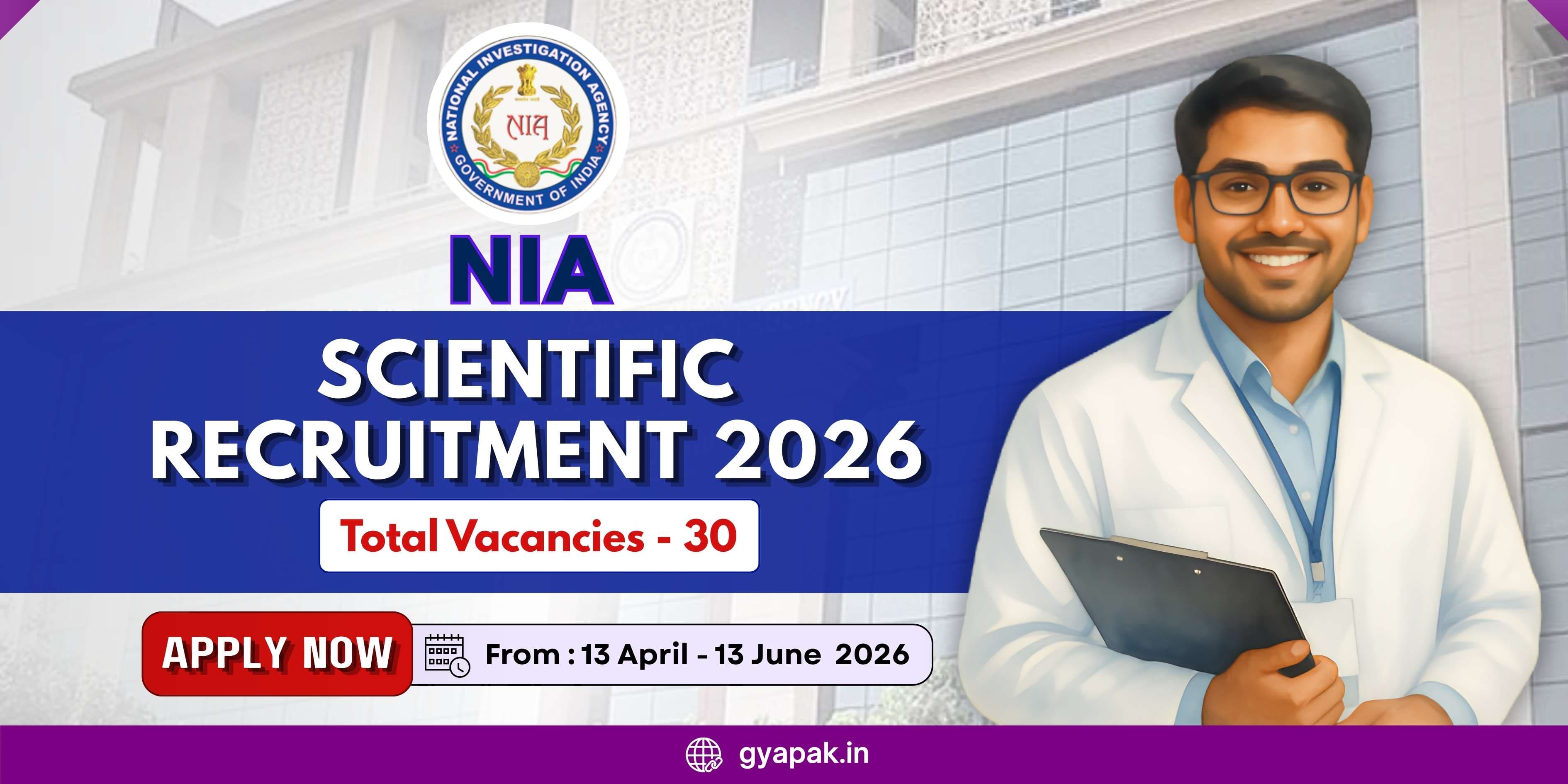
The Ministry of Home Affairs (MHA) has released the official notification for NIA Scientific Recruitment 2026. This recruitment is being conducted on a Deputation (ISTC) basis to fill 30 critical positions at the NIA Headquarters and its regional branches. From Cyber Forensic Examiners to Crime Scene Assistants, the agency is seeking qualified personnel currently serving in Central or State government departments. Issued under Advt No. E-79/001/Dep-Scientific/NIA/2026, this recruitment aims to bolster India's digital and physical forensic capabilities.
Post-wise Vacancy & Salary Details of Scientific jobs
| Post Name | Vacancies | Pay Scale (7th CPC) |
|---|---|---|
| Cyber Forensic Examiner | 18 | Level-10 (₹56,100 - ₹1,77,500) |
| Crime Scene Assistant | 06 | Level-7 (₹44,900 - ₹1,42,400) |
| Technical Forensic Psychologist | 03 | Level-10 (₹56,100 - ₹1,77,500) |
| Explosive Expert | 02 | Level-10 (₹56,100 - ₹1,77,500) |
| Finger Print Expert | 01 | Level-10 (₹56,100 - ₹1,77,500) |
Eligibility Criteria for NIA Recruitment 2026
Candidates must meet specific educational and professional benchmarks: Educational Qualification: Cyber/Forensic Roles: Master’s Degree in Criminology, Clinical Psychology, Forensic Science, or M.Sc. in relevant Science subjects. Technical Roles: B.E./B.Tech in Computer Engineering/IT or MCA/M.Tech in CS/IT. Experience: Generally requires 3 to 5 years of experience in crime scene processing or forensic examination within government departments. Age Limit: The maximum age for appointment by deputation shall not exceed 56 years as of the closing date.
NIA Scientific Recruitment Selection Process: Step-by-Step
The selection is a multi-stage vetting process designed to ensure only the most qualified and disciplined government officers are inducted into the agency. Step 1. Application Routing (Proper Channel) The first filter is the application itself. Unlike direct recruitment, an officer cannot apply directly. The "Proper Channel" Rule: Candidates must submit their bio-data (Annexure-II) through their current department's Cadre Controlling Authority (CCA). Initial Vetting: The parent department checks if the officer meets the service requirements (analogous post or required years in a specific pay level) before forwarding the application to the NIA. Step 2. Document Scrutiny & Dossier Evaluation Once the NIA receives the application, the selection committee performs a rigorous review of the following documents: APAR/ACR Review: The NIA evaluates the Annual Performance Appraisal Reports for the last 5 years. Officers with "Outstanding" or "Very Good" ratings are prioritized. Vigilance Clearance: A mandatory check to ensure there are no ongoing disciplinary or criminal proceedings against the officer. Integrity Certificate: A formal declaration from the parent department confirming the officer's professional honesty. Step 3. Personal Interaction / Interview For scientific and technical roles, the NIA typically conducts a Personal Interaction or interview. Technical Assessment: Candidates for roles like Cyber Forensic Examiner or Explosive Expert are questioned on their practical knowledge, recent case handlings, and familiarity with advanced forensic tools. Aptitude for Intelligence Work: The panel assesses the candidate’s psychological readiness for high-pressure investigative work. Step 4. Medical Examination & Character Verification Selected candidates must undergo a thorough medical check-up to ensure physical fitness for field duties. Additionally, the NIA may conduct its own independent background verification of the candidate’s character and antecedents. Step 5. Final Order & Induction Upon successful completion of all stages, a Non-Objection Certificate (NOC) is finalized between the NIA and the parent department, and the officer is officially inducted on deputation for an initial period of 3 years.
The "Deputation (ISTC)" Simplified
Cyber Forensic Examiners in the NIA are the digital detectives tracking international terror funding and encrypted communications. Highlight that this is a "Career of Honor" for existing government servants looking to move into high-stakes national security. Many aspirants get confused by "ISTC" (Including Short-Term Contract). Clarify for your readers that this means: You must already be a permanent employee in a Government/Semi-Govt body. The initial period is usually 3 years, extendable based on performance. You retain your lien in your parent department while enjoying NIA’s specialized allowances.
Allowances and Benefits of NIA Crime Scene Assistant Jobs
- Special Security Allowance (SSA): All NIA officers receive a 20% SSA of their Basic Pay. This is a significant boost compared to many other government departments.
- Dearness Allowance (DA): Based on the prevailing rates revised twice a year by the Central Government.
- House Rent Allowance (HRA): Admissible if government accommodation is not provided (rates vary by city: 9%, 18%, or 27%).
- Transport Allowance (TPT): Provided to cover commuting costs.
- Deputation Allowance: Admissible as per the Department of Personnel and Training (DoPT) guidelines for officers on deputation.
Application Checklist for Offline Submission of NIA Scientific Recruitment 2026
Since NIA Scientific Recruitment is an Offline Application, you must send: 1. Bio-data in the prescribed Annexure-II format. 2. APARs (Annual Performance Appraisal Reports) for the last 5 years. 3. Vigilance Clearance & Integrity Certificate. 4. Mailing Address: The SP (Admin), NIA HQ, Opposite CGO Complex, Lodhi Road, New Delhi-110003.
Job location for Scientific officer vacancy of NIA
For the NIA Scientific Recruitment 2026, the job location is theoretically All India Service, as the National Investigation Agency operates on a pan-India basis. 1. Primary Posting: NIA Headquarters (HO) Most scientific and technical roles, especially the Cyber Forensic Examiners and Technical Forensic Psychologists, are primarily based at the headquarters due to the centralized nature of their high-tech labs. Location: Opposite CGO Complex, Lodhi Road, New Delhi. 2. NIA Regional Branches (Across India) The NIA has a robust network of branch offices. Candidates recruited for roles like Crime Scene Assistants or Explosive Experts are often deployed to these regional hubs to ensure quick response times for investigations in those zones. The major branch locations include: North: Jammu, Chandigarh, Lucknow. South: Hyderabad, Kochi, Chennai, Bengaluru. East: Guwahati, Kolkata, Ranchi, Imphal. West: Mumbai, Ahmedabad. Central: Raipur. 3. Field Deployment (Operational Duty) It is important to clarify to your readers that these are not strictly "desk jobs." Crime Scene Assistants and Explosive Experts must travel to various locations across the country (often on short notice) to collect evidence from blast sites or crime scenes. The job involves field visits to support local police or NIA investigation teams wherever a case is registered.
Life at NIA: Beyond the Lab
- While "Scientific Officer" sounds like a desk-bound laboratory role, life at the National Investigation Agency (NIA) is a dynamic blend of high-tech forensics and high-stakes field operations. Working here isn't just about analyzing samples; it's about being an integral part of India’s counter-terrorism mission.
- A Scientific Officer at NIA must be as comfortable in a sterile laboratory as they are in a rugged field environment. When a high-profile case occurs—such as an IED blast or a major cyber-breach—Scientific Officers (especially Explosive Experts and Crime Scene Assistants) are often the first "technical" responders. They work alongside elite investigators to ensure that every piece of evidence, from a microscopic circuit board fragment to a trace of chemical residue, is preserved and documented.
- NIA officers often collaborate with international agencies (like the FBI or Interpol). You aren't just working for a local department; you are part of a global network fighting transnational crime.
- A Culture of Constant Learning: Officers regularly undergo specialized training at institutes like the National Forensic Sciences University (NFSU) or participate in international workshops to stay ahead of sophisticated criminal tactics.
- Interdisciplinary Work: You’ll find yourself working with top-tier IPS officers, legal experts, and intelligence analysts. This cross-functional environment provides a learning curve that few other government roles can match.
Frequently Asked Questions
Comments
Login to join the discussion
Log inNo comments yet