

GSSSB Pharmacist Recruitment 2026 Introduction
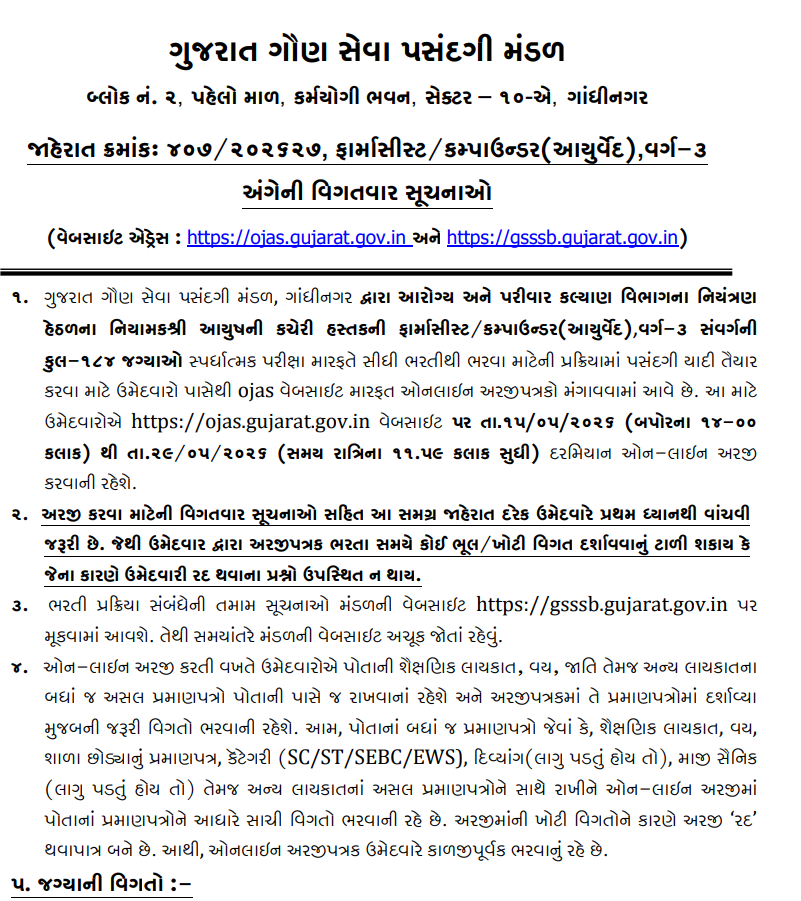
The Gujarat Gaun Seva Pasandgi Mandal (GSSSB) has officially opened applications for a prime pharmacist vacancy, offering 184 seats for the post of Pharmacist / Compounder (Ayurveda), Class-3, under the Directorate of AYUSH. This highly anticipated recruitment drive marks a significant opportunity for professionals seeking stable, high-paying jobs in ayurveda within the Gujarat state healthcare infrastructure. With the online application window active from May 15 to May 29, 2026, eligible candidates looking to secure a career as an ayurveda pharmacist are encouraged to apply early through the official OJAS portal to avoid last-minute technical bottlenecks. The selection framework has been structured around a single-stage, comprehensive competitive examination consisting of 210 marks. Unlike traditional recruitment formats that utilize multiple tiers, this direct selection process places a heavy premium on core subject expertise, with over 70% of the total marks dedicated exclusively to technical Ayurvedic pharmacy topics. However, candidates must navigate a rigorous evaluation blueprint that includes a negative marking penalty of 0.25 and a strict 40% independent qualifying threshold for both the general and technical sections, making a balanced preparation strategy essential for success.
Vacancy Details of jobs in ayurveda
| Category | No. Of Vacancies |
|---|---|
| General (Unreserved) | 88 |
| SEBC | 41 |
| ST | 32 |
| EWS | 18 |
| SC | 05 |
Eligibility Criteria for GSSSB Pharmacist vacancy
Educational Qualification: Option 1: B.Pharm (Ayurveda) from a recognized university. Option 2: D.Pharm (Ayurveda) from a recognized university PLUS 2 years of experience as a Pharmacist/Compounder in a Government/Local Body/Board/Corporation. Computer Knowledge: Candidates must possess basic knowledge of computer operations. Language Proficiency: Adequate knowledge of Gujarati, Hindi, or both is mandatory. Age Limit (as of May 29, 2026) General (Male): 18 to 35 years General (Female): 18 to 40 years (5 years relaxation) Reserved Category (Male): 18 to 40 years Reserved Category (Female): 18 to 45 years
Selection Process for GSSSB ayurveda pharmacist
- 1Written Competitive Examination: A single stage MCQ-based exam (CBRT or OMR). Total questions: 210, Duration: 3 hours
- 2Document Verification: For candidates who clear the merit cut-off.
Salary Structure for Pharmacist vacancy
- First 5 Years (Fixed Pay): Rs 40,800 per month.
- After 5 Years (Regular Pay): Rs 29,200 – Rs 92,300 (Pay Level-5 as per 7th CPC).
Exam pattern for ayurveda pharmacist
| Part | Subject / Section | Questions | Marks |
|---|---|---|---|
| Part-A | General Studies, Language, & Reasoning | 60 | 60 |
| Part-B | Technical Subject (Ayurveda/Pharmacy) | 150 | 150 |
Syllabus for GSSSB ayurveda pharmacist
Part-A: General Awareness & Basic Skills (60 Marks) This section tests the candidate's general knowledge and foundational skills. General Studies: History of Gujarat, Geography of Gujarat, Indian Constitution, Current Affairs (National and State level), and General Science. Reasoning & Arithmetic: Logical reasoning, series completion, coding-decoding, and basic mathematical operations. Languages: Gujarati: Grammar, vocabulary, and comprehension. English: Basic grammar, synonyms, antonyms, and sentence structure. Part-B: Subject-Specific (150 Marks) This section is the most critical and focuses on the technical expertise required for the role of an Ayurveda Pharmacist. Bhaishajya Kalpana: Principles of Ayurvedic pharmacy, preparation of various dosage forms (Churna, Vati, Asava, Arishta, etc.). Dravyaguna Vigyan: Knowledge of medicinal plants, their identification, properties (Rasa, Guna, Virya, Vipaka), and therapeutic uses. Rasa Shastra: Processing of minerals, metals, and animal products in Ayurveda (Shodhana, Marana). Ayurvedic Pharmaceutics: Standard Operating Procedures (SOPs), quality control, and standardization of Ayurvedic drugs. Pharmacy Acts & Regulations: Drugs and Cosmetics Act (specifically provisions related to Ayurveda), Pharmacy Act, and ethics. Hospital & Clinical Pharmacy: Inventory management, storage of medicines, and dispensing procedures in an Ayurvedic setup.
Preparation tips for jobs in ayurveda
- Focus on Part-B: Since 71% of the marks come from the technical subject, prioritize the B.Pharm/D.Pharm (Ayurveda) core curriculum.
- Gujarati Language: Many candidates lose marks in the grammar section; regular practice of high-school level Gujarati grammar is essential.
- Time Management: With 210 questions to solve in 180 minutes, speed and accuracy are vital. Practice with previous GSSSB technical exam papers.
How to apply for GSSSB Pharmacist Recruitment 2026
- 1Visit the official OJAS Gujarat portal: ojas.gujarat.gov.in. If you are a new user, click on the "Registration" tab on the top menu and select "Apply".
- 2Fill in your basic details (Name, Father’s Name, Date of Birth, Gender, Address, Mobile Number, and Email ID). Verify your mobile number via OTP to complete the registration. You will receive a unique Registration Number.
- 3On the homepage, hover over the "Online Application" tab and click on "Apply". Select "GSSSB (Gujarat Subordinate Service Selection Board)" from the department dropdown menu.
- 4Locate the advertisement number 407/2026-27 for the post of Pharmacist / Compounder (Ayurveda), Class-3. Click on the "Apply Now" button next to it.
- 5Enter your Registration Number and Date of Birth to auto-fill your saved profile details, or select "Skip" to fill the form manually.
- 6Provide your educational qualifications (B.Pharm/D.Pharm details, university, passing year, and marks), computer knowledge status, and language proficiency.
Breaking Down the Structural Facts about GSSSB Recruitment 2026
- This recruitment is explicitly for the Ayurveda branch under the Directorate of AYUSH, distinct from generic or allopathic pharmacy recruitment drives.
- The 210-Mark Core Blueprint: The assessment completely bypasses multi-tier formats (like Prelims/Mains) in favor of a single-stage, 3-hour competitive exam worth 210 marks.
- The marks distribution is heavily skewed toward technical expertise. Part-A (60 Marks / 28.5%): Quantitative Aptitude, Mental Ability, Indian Constitution, Current Affairs, and Gujarati/English comprehension. Part-B (150 Marks / 71.5%): Core Ayurveda Pharmacy subjects (Bhaishajya Kalpana, Dravyaguna Vigyan, Rasa Shastra, and Pharmacy Acts)
- Unlike older Class-3 state exams where overall merit was the sole driver, GSSSB enforces a strict 40% minimum qualifying standard independently in both Part-A and Part-B. Falling short of 24 marks in Part-A or 60 marks in Part-B results in immediate disqualification, regardless of the aggregate score.
- Two-Tier Eligibility Entry: Academic entry points are strictly dual-tracked. Candidates need either a flat B.Pharm (Ayurveda) degree OR a D.Pharm (Ayurveda) backed by exactly 2 years of verified institutional experience in public/government-aligned bodies.
Preparation Strategy for GSSSB Pharmacist vacancy
- The 70:30 Preparation Rule: Candidates must structure their study schedule to reflect the marks distribution. Seventy percent of the daily preparation block should be dedicated to mastering deep academic concepts in Bhaishajya Kalpana and Dravyaguna Vigyan. The remaining thirty percent must focus on fast arithmetic and reasoning practice to comfortably clear the 24-mark safety margin in Part-A.
- The "First-Hour" Exam Execution Strategy: Given that 210 questions must be processed in 180 minutes, speed is a major constraint. The most efficient approach is to spend the first 60 minutes answering the 150 technical questions in Part-B that require no calculation, securing the core marks quickly. The remaining two hours can then be systematically divided between the general studies section and time-consuming mathematics puzzles.
- Zero-Mistake Application Timelines: Because the application window is narrow (May 15 to May 29, 2026), the system will experience heavy traffic bottlenecks in the final 48 hours. Eligible candidates should submit their forms on the OJAS portal early, ensuring photo/signature dimensions are kept strictly under the 15 KB limit to avoid automated system rejections.
Comments
Login to join the discussion
Log inNo comments yet