
DMER Maharashtra Recruitment 2026 Introduction
The Commissioner of Medical Education, Research & Ayush, Mumbai has issued an official recruitment notification for the sanctioned posts of Tutors and Junior Residents at Government Medical Colleges in Maharashtra. Total 935 openings to be filled during this recruitment campaign, 650 for Tutors and 285 for Junior Residents. These projects are contractual and only for a period of one year. The application process is open and accessible through a centralised web site, providing a smooth and transparent selection cycle. The candidates should be MBBS from a recognised college and should have a valid registration with Maharashtra Medical Council. It is worth mentioning that the recruiting process has an inclusive age limit of up to 70 years, enabling a large number of medical experts to help improve the healthcare and educational infrastructure of the state. Selection to such positions is not through a regular entrance exam but is based on merit. The priority is given to the MBBS degree exams with respect to academic excellence. The whole procedure is supposed to be quick, from the initial application phase in mid-May to the final allotment of posts by the end of the month. The project is a strategic move by the state to quickly fill clinical and teaching departments with qualified specialists and provides a substantial monthly salary ranging from Rs. 79,173/- to Rs. 80,000/-.
Vacancy Details of DMER Junior resident and Tutor
| Post Name | Total Vacant Posts | Monthly Fixed Salary |
|---|---|---|
| Tutor | 650 | Rs. 80,000/- |
| Junior Resident | 285 | Rs. 79,173/- |
| Total | 935 | - |
Important dates for DMER medical jobs
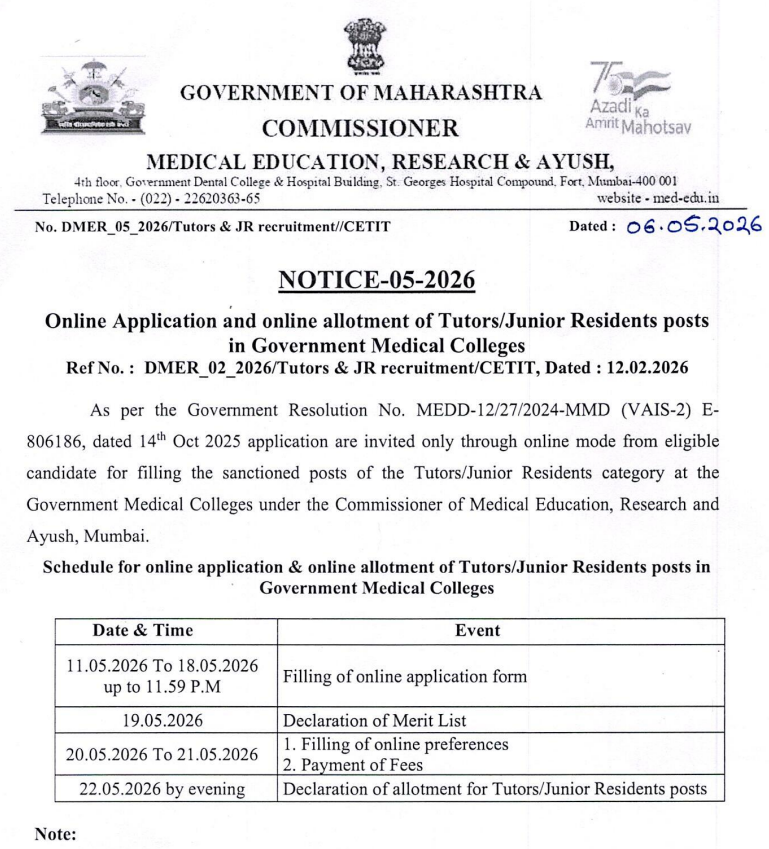
The recruitment process for the DMER Maharashtra Tutor and Junior Resident positions follows a tight schedule starting in May 2026. The online application window opens on May 11, 2026 and remains active until May 18, 2026. Immediately following the application deadline, the authorities will declare the merit list on May 19, 2026. Once the list is out, eligible candidates must move quickly to fill their online preferences and pay the required fees between May 20, 2026 and May 21, 2026. The final declaration of allotment for Tutor and Junior Resident posts is scheduled for the evening of May 22, 2026. Upon receiving an allotment letter via email, selected candidates are required to report and join their respective institutes within 7 days.
Eligibility and Selection
- Qualification: Candidates must have an MBBS degree from a recognized medical college and a valid Maharashtra Medical Council registration.
- Age limit: Up to 70 years.
- Selection Basis: Allotment is based on MBBS marks merit and reservation criteria. Candidates with specialization (MD/MS/DM/MCH/DNB/CPS) in the concerned subject are preferred over MBBS candidates.
- Joining: Selected candidates must join within 7 days of allotment.
Application Fee for DMER Maharashtra Recruitment 2026
The application fee for DMER Maharashtra Junior resident and Tutor Jobs is non-refundable. Open Category: Rs 1000 Reserved category: Rs 900
Required documents for medical jobs
Applicants must upload scanned copies of 1) MBBS degree and all marksheets. 2) Internship completion and registration certificates (MMC/NMC) 3) Government photo ID (Aadhar/PAN/Passport) and a recent photo. 4) Relevant reservation certificates (Caste, validity, Non-creamy layer, etc) if applicable.
Selection Criteria and Merit List of Junior resident
There is no traditional written exam for this recruitment; selection is based on the MBBS merit list. Merit calculation: Ranking is determined by the total marks (converted to percentage) obtained in the first, second and third MBBS (Part I and Part II) examinations combined. Tie-breaker rules: 1. Candidates from an older admission batch will be given preference. 2. Older candidate by DOB will be preferred.
How to apply for DMER Maharashtra Recruitment 2026
- 1Go to the specified recruitment website (med-edu.in or dmer.maharashtra.gov.in).
- 2Complete the online application form between May 11, 2026, and May 18, 2026.
- 3Upload scanned copies of your MBBS degree, marksheets, internship certificate, registration certificate (MMC/NMC), and photo ID .
- 4Pay the non-refundable fee online: Open Category: Rs. 1,000/-. Reserved Category: Rs. 900/-.
- 5After the merit list is declared (May 19), candidates must fill their college/subject preferences and pay additional fees between May 20 and May 21, 2026.
- 6Download the allotment letter on May 22, 2026, and join the assigned institute within 7 days.
Job Profile of DMER Tutor and Junior Resident
The recruitment for Tutors and Junior Residents is for positions within Government Medical Colleges under the Commissioner of Medical Education, Research and Ayush, Maharashtra. While the specific list of all participating colleges is available in the detailed information on the official website (www.dmer.maharashtra.gov.in), the notification highlights the following details regarding locations and placement: - Institution Type: All vacant posts are located at Government Medical Colleges across the state of Maharashtra. - Allotment Process: Candidates are allotted to specific institutes based on their merit ranking and the preferences they submit online between May 20 and May 21, 2026. - Headquarters: The administrative office overseeing the recruitment is located at the 4th floor, Government Dental College & Hospital Building, St. Georges Hospital Compound, Fort, Mumbai. - Vacancy Flexibility: The number of vacant posts at specific institutes is subject to change at any time. - Reporting: Once an allotment letter is generated, selected candidates must join their assigned institute within 7 days
Important facts about DMER Maharashtra Recruitment 2026
1. Fast-Track Recruitment Cycle The timeline is exceptionally compressed, with only 12 days spanning the start of applications (May 11) to the final allotment (May 22). This indicates an urgent administrative need to fill these positions before the start of the next academic or clinical term. 2. Emphasis on Academic Excellence Unlike many government recruitments that rely on entrance exams, this process is purely merit-based, focusing on the cumulative percentage of all MBBS years. This prioritizes candidates with a consistent record of high academic performance throughout their undergraduate medical education. 3. Preferential specialized staffing The policy explicitly grants preference to candidates with post-graduate qualifications (MD/MS/DNB, etc.). This suggests that while the base requirement is an MBBS, the department’s true objective is to staff these roles with specialists to improve the quality of clinical teaching and patient care in government hospitals. 4. Senior Talent Utilization The upper age limit of 70 years is a significant insight. It allows retired medical professionals and senior practitioners to re-enter the government workforce, helping to bridge the gap in clinical expertise and mentorship that often exists in newer or rural medical colleges. 5. Temporary Workforce Strategy The fixed one-year duration and "Fix Pay" salary structure (approx. ₹80,000) mark these as non-permanent, contractual roles. This allows the government to maintain a flexible workforce that can be adjusted annually based on vacancy fluctuations without the long-term financial commitments of permanent civil service positions. 6. Complex Social Engineering The vacancy tables show a highly detailed horizontal reservation system. Beyond standard caste categories, the inclusion of specific quotas for project-affected persons (5%), earthquake-affected persons (2%), and part-time graduates (10%) reflects a deep integration of Maharashtra's specific socio-economic welfare policies into its medical hiring.
Strategic conclusion of DMER recruitment
The DMER Maharashtra Tutor and Junior Resident Recruitment 2026 represents a highly structured, efficiency-driven approach to staffing the state’s medical education sector. By synthesizing the provided notification, we can draw the following conclusions about its impact and strategic design: 1. Administrative Efficiency and Speed The most striking feature of this recruitment is its 12-day lifecycle. By bypassing a written examination and relying on verified MBBS academic records, the Commissioner has created a "plug-and-play" recruitment model. This suggests a critical administrative priority to minimize the vacancy gap in Government Medical Colleges with minimal bureaucratic lag. 2. Balancing Youth with Experience The recruitment strategy creates a unique professional intersection: - The Bridge Role: For fresh graduates, these one-year posts serve as a vital professional bridge, offering a high fixed salary and institutional experience while they prepare for further specialization. - Expert Retention: The high age limit of 70 years indicates a conscious effort to retain or re-attract seasoned clinicians and educators into the public system, potentially to meet National Medical Commission (NMC) faculty requirements. 3. Strategic Labor Cost Management By utilizing a "Fix Pay" model (₹80,000 for Tutors and ₹79,173 for JRs), the state manages its healthcare budget with high predictability. Since these are one-year postings without the long-term pension or benefit liabilities of permanent civil service roles, the government can maintain a robust clinical workforce that is financially sustainable and easy to rotate. 4. Granular Social Inclusion The synthesis of the vacancy tables reveals that this is not just a medical recruitment but a tool for social equity. The inclusion of specific, small-percentage quotas for earthquake-affected (2%), project-affected (5%), and orphan (1%) candidates demonstrates that the Maharashtra government is using high-value medical roles to fulfill specific state-level socio-economic mandates. 5. Quality Assurance through Preference While the minimum qualification is an MBBS, the "Specialization Preference" rule acts as a silent quality filter. By prioritizing MD/MS/DNB holders, the department ensures that even though the posts are titled "Junior Resident" or "Tutor," the actual level of expertise in the classroom and ward could be significantly higher, thereby elevating the standard of medical education in the state.
Frequently Asked Questions
Comments
Login to join the discussion
Log inNo comments yet